
Section 1
Why Risk Understanding Matters
Every day, organisations invest significant resources in protecting their people, assets and operations. Security Officers patrol premises, CCTV cameras monitor critical areas, access control systems regulate entry, and visitor management procedures help safeguard facilities against unauthorised access.
Yet despite these measures, security incidents continue to occur. Equipment is stolen from supposedly secure facilities. Unauthorised individuals gain access to restricted areas. Business operations are disrupted by incidents that, in hindsight, appear preventable.
When these events occur, organisations ask the same questions: How did this happen? Could we have prevented it? Were there warning signs we failed to recognise?
In many cases, the answer is not an absence of security measures. It is an absence of understanding. A CCTV camera cannot monitor a vulnerability that was never identified. A Security Officer cannot effectively protect an area that was never recognised as high risk.
This is where a Security Risk Assessment becomes essential. Rather than waiting for incidents to expose weaknesses, it enables organisations to identify vulnerabilities before they are exploited, understand which risks matter most, and implement measures that strengthen security while supporting operations.
Executive Insight
A Security Risk Assessment changes the conversation from reacting to incidents to preventing them.
Section 2
Security Begins with Understanding Risk
When organisations discuss improving security, conversations often start with solutions: more Security Officers, more cameras or upgraded access control.
These are reasonable questions, but they are rarely the first ones that should be asked. Before deciding how security should be improved, organisations need to understand what risks they are actually trying to manage.
Diagnosis Before Prescription
Understand the problem before selecting the solution.
A responsible doctor does not prescribe treatment before diagnosing the problem. Security should work the same way. Installing more cameras, deploying additional officers or investing in new technology before understanding the risk may simply increase cost without addressing the real problem.
Effective security is not measured by how much security an organisation has. It is measured by whether that security addresses the organisation's actual risks.
Operational Insight
Adding manpower or technology without diagnosing the underlying risk can produce more cost, more complexity and very little improvement.
Section 3
What Is a Security Risk Assessment?
A Security Risk Assessment is a structured process used to identify, evaluate and prioritise risks to an organisation's people, assets and operations. Rather than looking at individual security measures in isolation, it examines the organisation as a whole to determine whether existing controls fit its operating environment.
What are we protecting?
People, physical assets, sensitive information, infrastructure, reputation and operational continuity.
What could threaten those assets?
Credible threats such as theft, unauthorised access, insider threats, sabotage and operational disruption.
Where are the vulnerabilities?
Process gaps, CCTV blind spots, outdated access permissions, weak visitor controls or risky everyday habits.
What should be done?
Targeted and proportionate improvements across procedures, awareness, manpower deployment and technology.
What Are We Protecting?
Every organisation has assets that matter. These may include employees and visitors, buildings and facilities, equipment and inventory, business information, critical infrastructure, operational processes and corporate reputation.
A warehouse storing high-value inventory has different priorities from a corporate office managing sensitive information. A residential development faces different concerns from a data centre supporting critical digital infrastructure. Security must therefore begin with context.
What Could Threaten Those Assets?
Threats may include theft, unauthorised access, insider threats, vandalism, sabotage and operational disruption. The purpose is not to imagine every possible scenario, but to focus on threats that are credible and relevant to how the organisation actually operates.
Where Are the Vulnerabilities?
A threat becomes serious when a vulnerability exists for it to exploit. Examples include weak visitor verification, CCTV blind spots, outdated access permissions, poorly controlled service entrances, inadequate lighting or risky habits that have become normalised through everyday operations.
What Should Be Done?
Sometimes the answer is technology. Sometimes it is a change in procedure, staff awareness or the way existing manpower is deployed. The objective is not to eliminate every risk. It is to reduce risk to an acceptable level while supporting, rather than hindering, how the organisation operates.
Section 4
Why Every Organisation Needs One
Security incidents are often described as unexpected. In reality, many are unanticipated rather than unpredictable. The warning signs were often present. They simply went unnoticed or became accepted as part of daily routine.
A delivery driver may be waved through without verification because “he comes here every day.” A rear entrance may no longer close properly but remain in use because it is convenient. Visitors may follow staff into secure areas without registering because someone upstairs is expecting them.
Nothing happens - until one day, something does. A Security Risk Assessment helps organisations identify these gaps before they become tomorrow's incident report.
From Reactive to Proactive
Many organisations strengthen security only after something goes wrong. A theft leads to more cameras. An unauthorised entry leads to stricter procedures. These responses may be necessary, but the incident has already happened.
Executive Insight
A mature security programme asks not only “What happened?” but “What could happen, and what can we do today to reduce that risk?”
Protecting More Than Physical Property
Organisations have far more at stake than buildings and equipment. People, information, operations, reputation, client confidence and business continuity may all be affected by a single security failure.
Supporting Business Continuity
A security incident rarely remains confined to the security function. It can halt production, delay deliveries, damage equipment and consume significant management time. Identifying vulnerabilities early strengthens the organisation's ability to continue operating when the unexpected occurs.
Making Smarter Security Investments
Without a structured assessment, organisations often respond by adding resources: more officers, more cameras, more technology. But more security does not automatically mean better security. A proper assessment identifies the root cause so the organisation can invest more intelligently rather than simply invest more.
Section 5
What Does an Assessment Actually Cover?
No two organisations are identical, so a credible assessment should never rely on a generic checklist alone. It considers how people, procedures, physical measures and technology interact within the organisation's actual operating environment.
Physical Security
Entrances, perimeter protection, lighting, loading areas, doors, secure storage and other physical safeguards.
Access Control & Procedures
Employee access, visitor verification, contractors, temporary passes, deliveries, vehicles and restricted areas.
Security Personnel
Post locations, patrol routes, shift coverage, reporting responsibilities and emergency roles.
Security Technology
CCTV, electronic access control, visitor management, alarm systems, monitoring and analytics.
Physical Security
Assessors may examine entrances, exits, perimeter protection, lighting, loading bays, service areas, secure storage and other physical features that influence how easily an unauthorised person could enter, move through or interfere with the site.
Access Control & Procedures
Access control is more than electronic cards. It includes employee permissions, visitor registration, contractors, temporary passes, vehicles, deliveries, restricted areas and after-hours access.
Security Personnel
The question is not simply whether Security Officers are present, but whether they are deployed effectively. Post locations, patrol routes, shift coverage, reporting procedures and emergency responsibilities should all reflect the actual risks of the site.
Security Technology
CCTV, electronic access control, visitor management platforms, intrusion detection and analytics can all support security operations. But technology alone does not create security. It must be integrated with sound procedures and people who understand how to respond.
Operational Insight
If one part of the security system is weak, the effectiveness of the other controls can be reduced. The goal is integration, not accumulation.
Section 6
When Should an Organisation Conduct One?
The simplest answer is: before an incident forces you to. There are, however, several situations where a Security Risk Assessment is especially valuable.
Before Occupying New Premises
New layouts, access points and workflows are easier to secure properly before operations begin.
Before Awarding or Renewing a Security Contract
Manpower levels should follow current operational risk rather than historical deployment arrangements.
Following a Security Incident
Review what failed, why it failed and what should change to reduce the likelihood of recurrence.
During Renovation or Expansion
Temporary access routes, contractors and changes to normal movement can quietly introduce new vulnerabilities.
When Operations Change
Extended hours, increased visitor activity, new contractors, equipment or work patterns can alter the risk profile.
Before Investing in New Security Technology
Technology should address an identified operational need rather than simply reflect what is available in the market.
As Part of Periodic Review
Threats evolve, controls deteriorate and procedures become outdated. Good security is never static.
Executive Insight
Security arrangements should evolve with the organisation. Changes to premises, operating hours, technology, contractors or business activities can all change the risk profile.
Section 7
Common Misconceptions
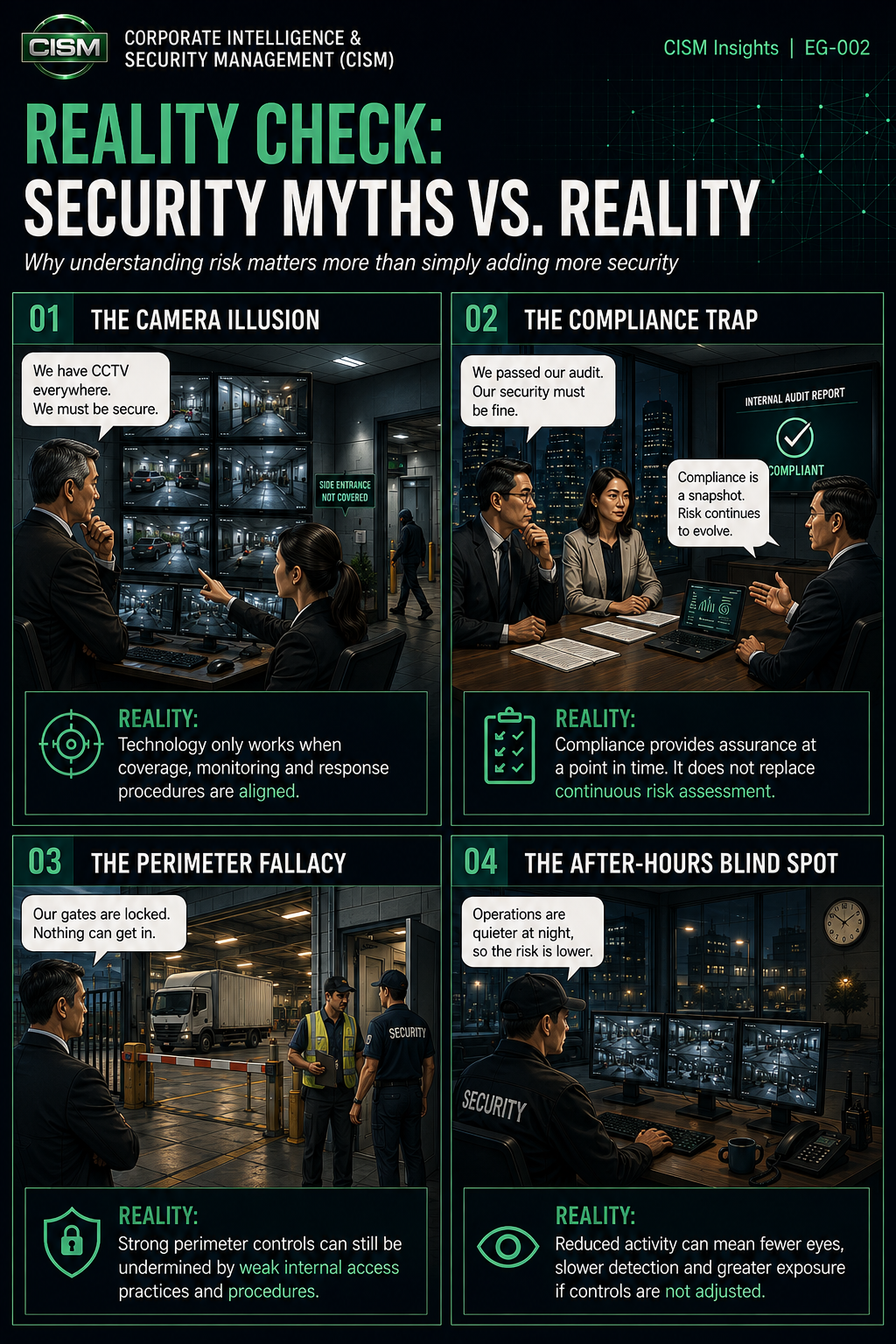
Security decisions are often shaped by assumptions that sound reasonable but can create blind spots. A structured assessment helps challenge those assumptions before they influence operational decisions.
"Nothing Has Ever Happened Here."
The absence of past incidents does not prove the absence of risk. It may simply mean vulnerabilities have not yet been exploited.
"We Already Have Security Officers."
Security Officers are important, but they must be supported by effective procedures, appropriate technology and sound operational planning.
"We Have CCTV Everywhere."
Cameras require appropriate coverage, monitoring and response procedures. Technology that is poorly integrated may only document a failure after it occurs.
"Risk Assessments Are Only for High-Security Facilities."
Every organisation has people, assets and operations worth protecting. The risks differ, but the need to understand them remains.
"A Security Risk Assessment Is Too Expensive."
The better question is what an unidentified vulnerability could cost through theft, downtime, investigation, disruption or reputational harm.
"We Conducted One Years Ago."
An old assessment reflects an old operating environment. If the organisation has changed, the risk profile may have changed as well.
"More Security Means Better Security."
More manpower or technology can increase cost without reducing risk when controls are not aligned with the actual problem.
Operational Insight
Effective security is about suitability, alignment and root causes. More manpower or technology is only useful when it addresses a clearly identified risk.
Section 8
How CISM Approaches Security Risk Assessments
At Corporate Intelligence & Security Management (CISM), we believe effective security starts with understanding the organisation before recommending solutions.
Every organisation operates within a unique environment shaped by its people, facilities, activities and operational priorities. For this reason, our approach is risk-based rather than one-size-fits-all.
A CISM assessment considers:
- Business operations and organisational priorities.
- Physical environment and site layout.
- Movement of employees, visitors, contractors and vehicles.
- Existing security measures and procedures.
- Critical assets and operational dependencies.
- Potential threats and vulnerabilities.
- Emergency preparedness and response arrangements.
- How manpower, procedures and technology interact.
The objective is not simply to list weaknesses. It is to understand which weaknesses matter most and recommend improvements that are practical, proportionate and aligned with the organisation's operating requirements.
Executive Insight
Effective security should support business operations, not unnecessarily complicate them. Recommendations should balance protection, practicality and operational needs.
Section 9
Key Takeaways
Every organisation faces security risks. Some are visible; others remain hidden until an incident exposes them. The organisations that are best prepared are not necessarily those with the most security. They are the organisations that understand their risks and make informed decisions before circumstances force their hand.
- Identify vulnerabilities before they are exploited.
- Understand which risks matter most.
- Move from reactive to proactive security.
- Protect people, assets and business operations.
- Strengthen business continuity and resilience.
- Make better-informed security investment decisions.
- Ensure security evolves alongside the organisation.
Executive Insight
The goal was never more security. It is better security.
Questions Worth Asking
- ✓Do we clearly understand our organisation's most significant security risks?
- ✓When was our last Security Risk Assessment conducted - and what has changed since?
- ✓Are our Security Officers deployed according to current risk rather than historical habit?
- ✓Are visitor and contractor access procedures consistently enforced?
- ✓Would we discover our vulnerabilities before an incident - or only after?
If several of these questions are difficult to answer confidently, it may be time to review the organisation's security posture.
A Security Risk Assessment provides the understanding needed to identify vulnerabilities, prioritise risk and select controls that genuinely support the organisation.
Understand the risk first. Then decide how best to manage it.