
Thinking about becoming a Security Officer in Singapore but not sure where to start?
For someone completely new to the industry, there can seem to be a lot to understand. Do you need a licence before you can work? Which courses must you complete? What is PRD? What happens after a company hires you? And if you start as a Security Officer, where can the career eventually lead?
The good news is that the process becomes much easier once it is broken into clear stages.
Understand What a Security Officer Actually Does
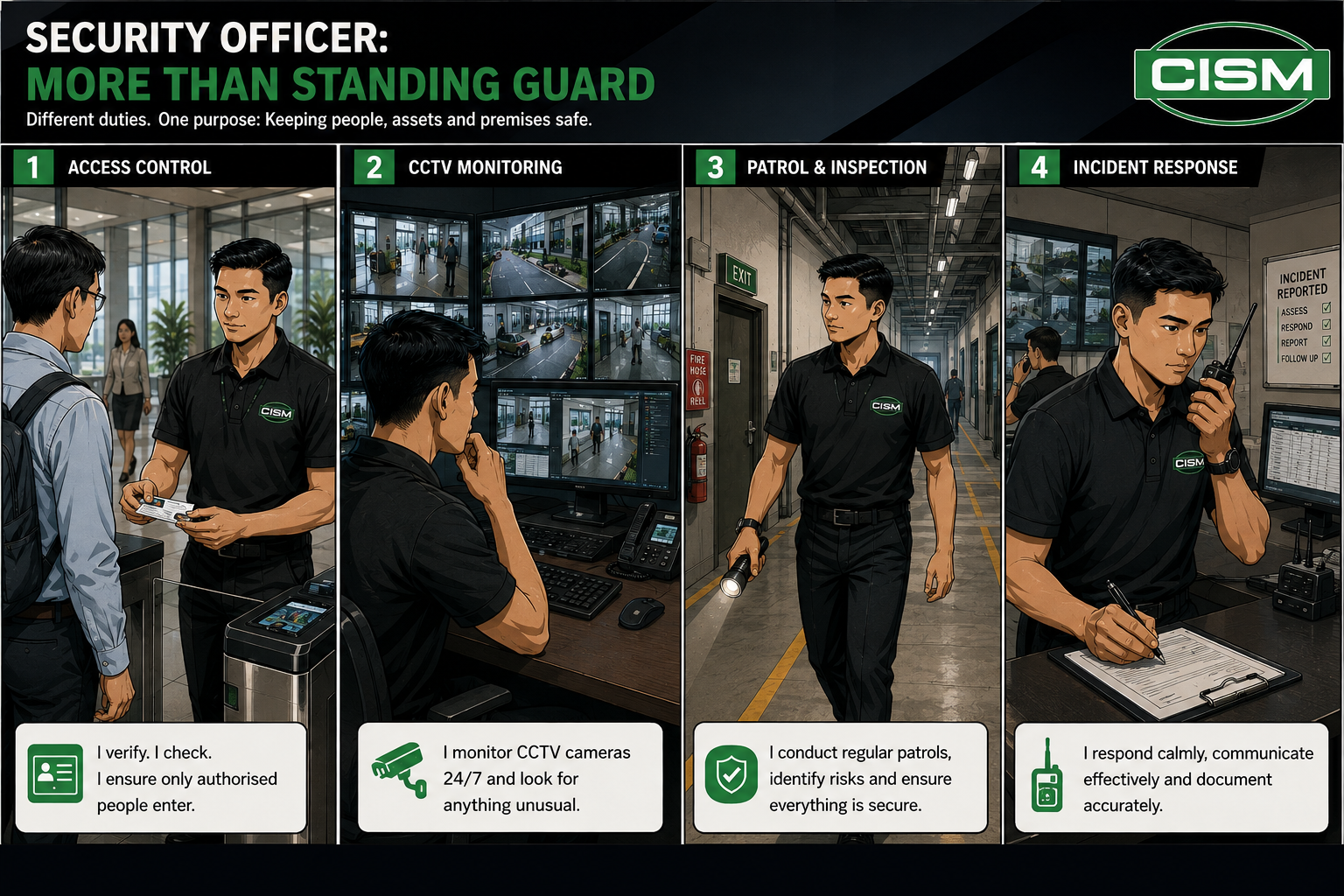
One of the biggest misconceptions about security work is that it simply involves standing at a guard post.
Modern security work can involve access control, screening, patrols, surveillance, incident response and the use of security systems. The exact responsibilities depend on the deployment.
- Verify employees, visitors and contractors.
- Control access into properties and restricted areas.
- Issue and collect visitor passes.
- Conduct patrols and identify abnormalities.
- Monitor CCTV and other security systems.
- Manage keys, passes and access credentials.
- Respond to alarms and incidents.
- Maintain operational records and reports.
- Support emergency procedures.
- Communicate professionally with clients, employees and members of the public.
Look beyond the salary
Before accepting a role, do not ask only, “How much does the job pay?”
Also ask, “What will I actually be doing at the site?”
Check Whether You Are Eligible
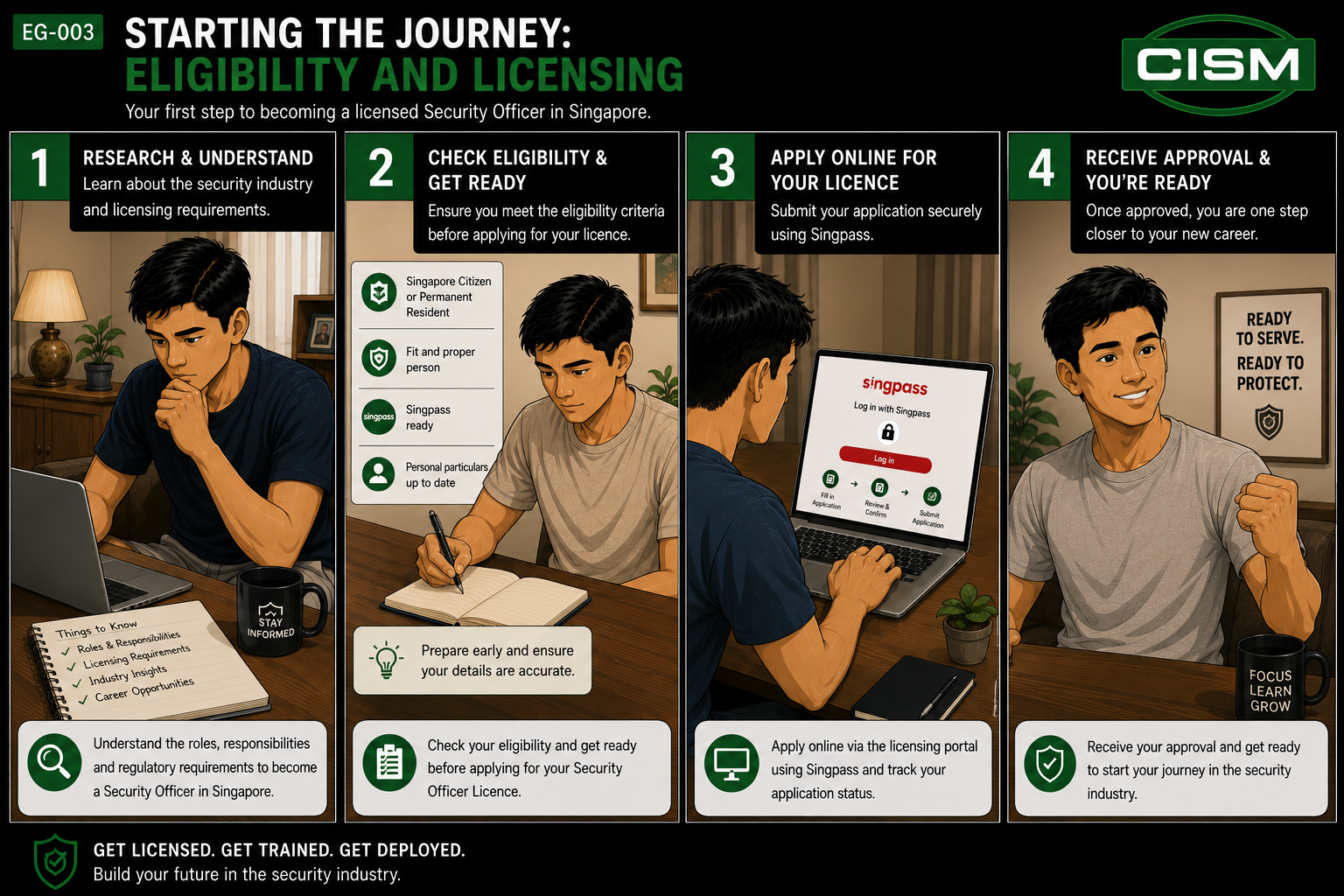
Before you can work as a Security Officer, you need to be eligible for a Security Officer licence.
Private security licensing is regulated by the Singapore Police Force through the Police Regulatory Department (PRD).
Applicants must meet the applicable fit-and-proper and residency or work-pass requirements. Eligible applicants include Singapore Citizens, Singapore Permanent Residents and eligible Malaysian citizens holding valid Singapore work passes. You can review the official Security Officer eligibility requirements published by the Singapore Police Force.
If you are a Malaysian work-pass holder
Additional supporting documents are required as part of the licence application, including the prescribed identity, passport, work-pass and criminal-record clearance documents (Good Conduct Certificate).
You cannot simply join a company, put on a security uniform and begin performing regulated security duties.
Apply for Your Security Officer Licence
Applications are made through GoBusiness using Singpass.
New Licence Fee
S$16
Validity
5 Years
Processing
3–4 Weeks
Applying today does not necessarily mean that you can begin deployment tomorrow. Plan ahead and ensure that the information and supporting documents submitted are complete and accurate.
Complete the Mandatory WSQ Security Training
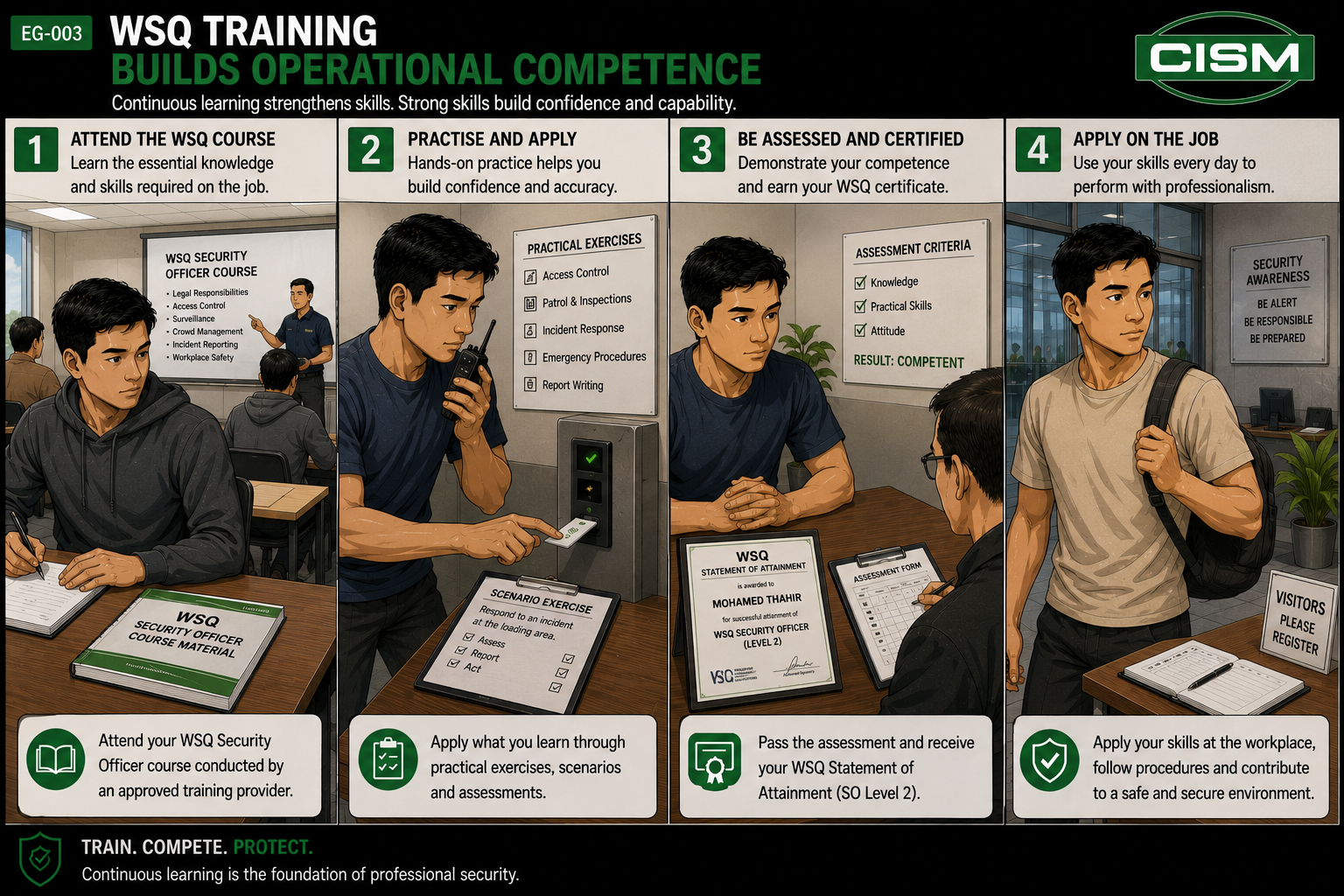
Security training falls under Singapore's Workforce Skills Qualifications framework, commonly known as WSQ.
For someone entering at the Security Officer grade, the current mandatory modules are listed under the official Security Progressive Wage Model training requirements.
Handle Security Incidents and Services
Provide Guard and Patrol Services
Recognise Terrorist Threats
Operate Basic Security Equipment
The objective is not simply to collect certificates. Training provides the operational foundation needed to recognise abnormalities, control access, respond to incidents and use security equipment appropriately.
Important 2026 training update
Existing Security Officers who have not completed Operate Basic Security Equipment (OBSE) have until 31 December 2026 to complete it. From 1 January 2027, completion becomes mandatory for continued deployment.
Obtain Your Security Officer ID Card
Once the relevant licensing and training requirements are in place, you will also need a Security Officer Identification Card.
Security Officer ID Card
Licensed Security Officers are required to carry the ID card while on duty. The application is administered by the Union of Security Employees (USE), and applications are made through the official Security Officer ID Card application process.
Current application fee: S$25
The card identifies you as a licensed Security Officer. It does not give you police powers.
Find the Right Security Job
Two vacancies may both be advertised as Security Officer roles, yet the actual working environments can be completely different.
Before accepting a position, understand the complete deployment, not just the advertised headline salary.
- Deployment location and transport considerations.
- Day or night shift arrangements.
- Working pattern and contractual hours.
- Actual duties and physical demands.
- Client expectations and site environment.
- Security systems or technology used.
- Additional certifications or site training required.
- Salary structure, allowances and benefits.
- Opportunities for development and progression.
Residential & Commercial
Visitor management, access control, patrols and regular interaction with residents, tenants, visitors or contractors.
Industrial Facilities
Vehicle access, contractor movement, perimeter security and structured operational procedures.
Corporate & Data Centres
Strict access control, monitoring systems, detailed records and highly structured procedures.
Screening Operations
People, bag or item screening using approved security processes and specialist equipment.
After You Are Hired: Your Employer Notifies PRD
Your employer handles this step - not you
When a security agency employs you, the company submits the required employment notification to PRD so that your employment is properly recorded.
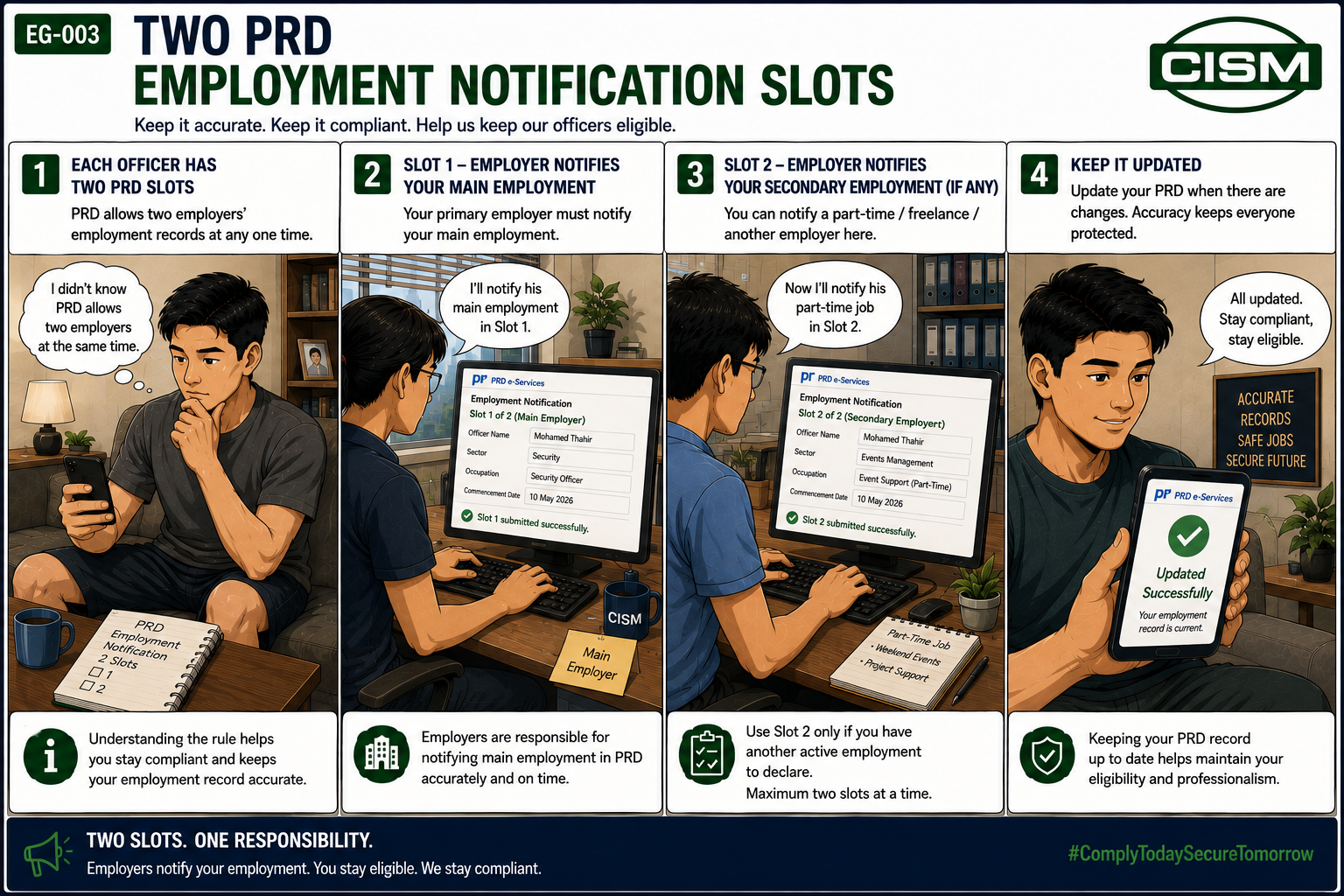
Understanding your two employment notification slots
A Security Officer can have up to two active employer notifications at the same time.
Notification Slot 1
Employer A
Notification Slot 2
Employer B
If both notification slots are already occupied, another employer cannot simply become a third concurrent notified employer. If an earlier employment has ended, the relevant employer may need to submit a cessation notification so that the employment record is updated.
This is why security agencies may check your notification status during recruitment and onboarding.
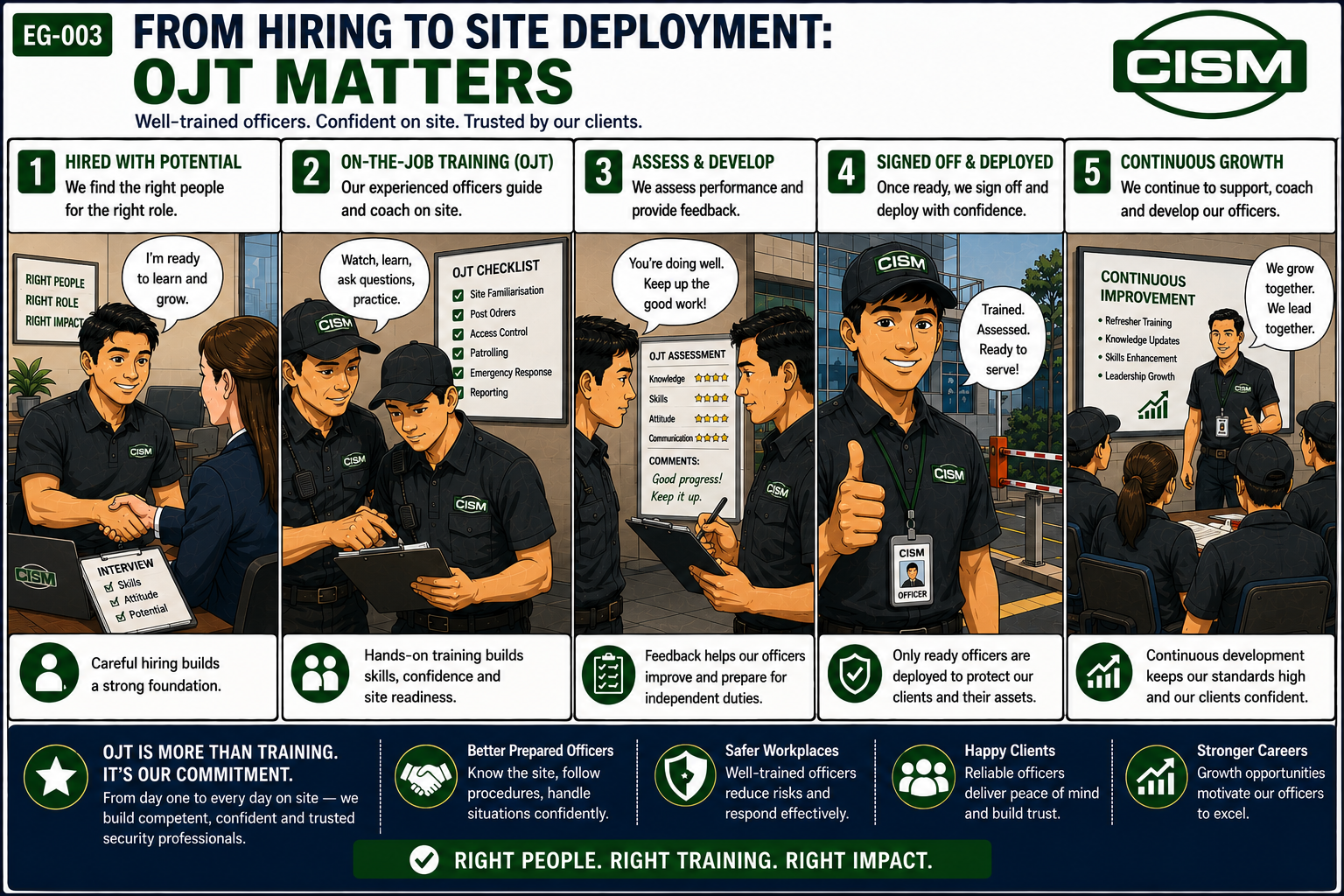
Site Induction and OJT: Becoming Ready for Deployment
Being licensed and WSQ-trained gives you the foundation to work in the security industry.
It does not automatically mean you understand every security site. Every deployment has its own environment, risks, procedures and client expectations.
- Site layout and access-control points.
- Post orders and standard operating procedures.
- Patrol routes.
- CCTV coverage and security equipment.
- Visitor-management procedures.
- Emergency exits and emergency response arrangements.
- Incident reporting and escalation requirements.
- Client-specific expectations.
Effective Deployment
Industry Competency + Site Competency
Specialised Roles
Some Security Jobs Require Additional Training
The mandatory SO modules establish the entry-level foundation. Some security functions require additional competencies.
Screening duties involving X-ray machines, walk-through metal detectors or hand-held metal detectors, for example, require the appropriate additional training.
Continuing to upgrade your skills can therefore increase the range of deployments and responsibilities available to you.
Medical Fitness
What If You Are Above 60?
Being above 60 does not automatically prevent someone from working as a Security Officer.
Officers above 60 must be certified medically fit for security work by a registered medical practitioner before deployment and must continue meeting the applicable medical-fitness requirements.
Why medical fitness matters
Security duties can involve prolonged standing, patrols, shift work and other physical requirements. The assessment helps confirm that an officer is medically suitable for the work.
PWM
Understanding the Security Progressive Wage Model
Another term you will hear frequently in the security industry is PWM - Progressive Wage Model.
In simple terms, the Security PWM combines wage requirements, training and recognised career progression for eligible security officers.
Wages
Minimum wage requirements for eligible local security officers.
Training
Required competencies linked to each occupational grade.
Progression
A structured pathway into more senior security responsibilities.
Career Progression
Moving From SO to SSO - and Beyond
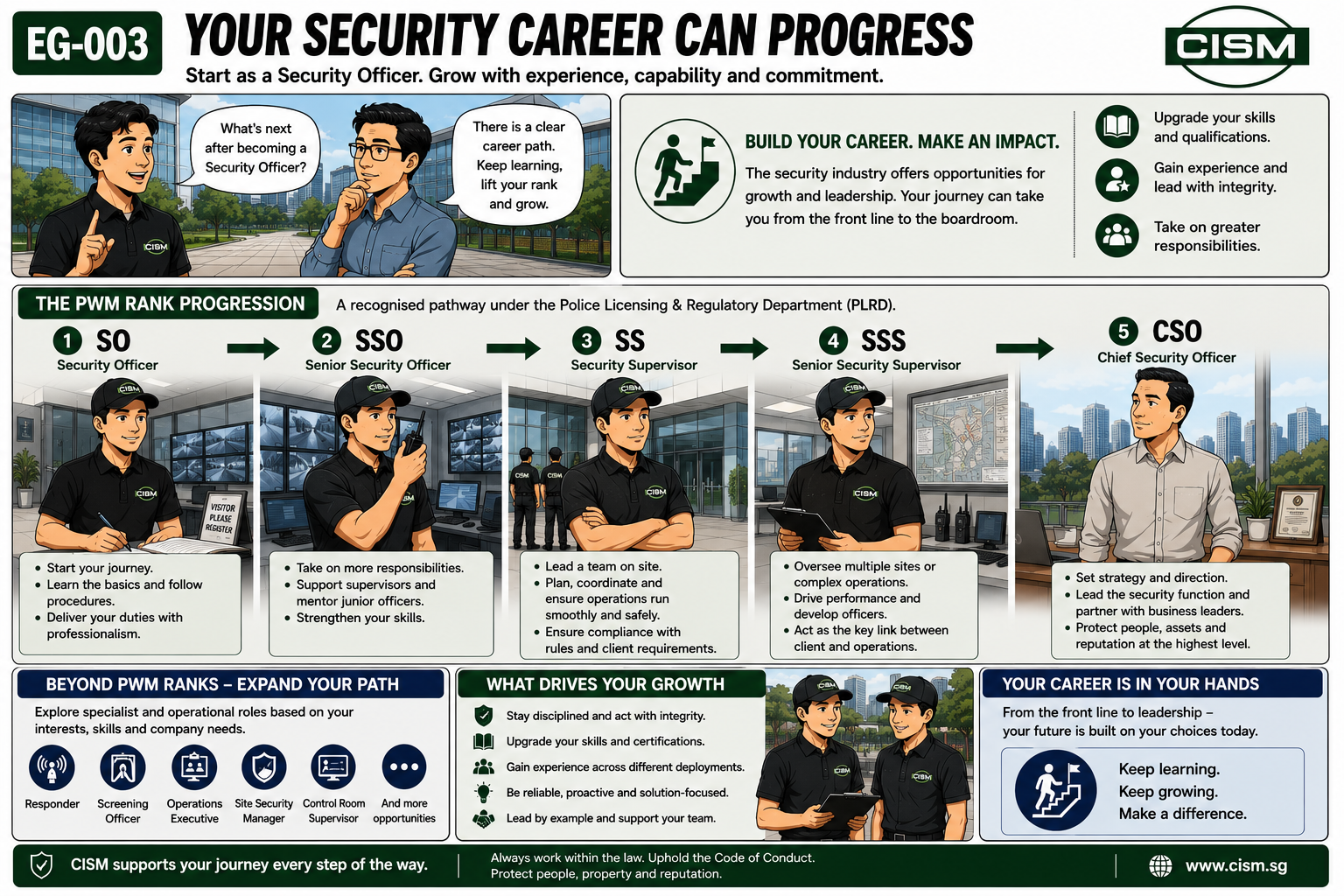
The recognised security career pathway is:
Security Officer
Senior Security Officer
Security Supervisor
Senior Security Supervisor
Chief Security Officer
Progression requires additional training and relevant work experience. For example, progression from Security Officer to Senior Security Officer requires at least six months' experience as an SO together with the prescribed SSO training modules.
Higher grades require progressively greater experience, competencies and responsibility.
Your Rank Is Not Your Only Career Path
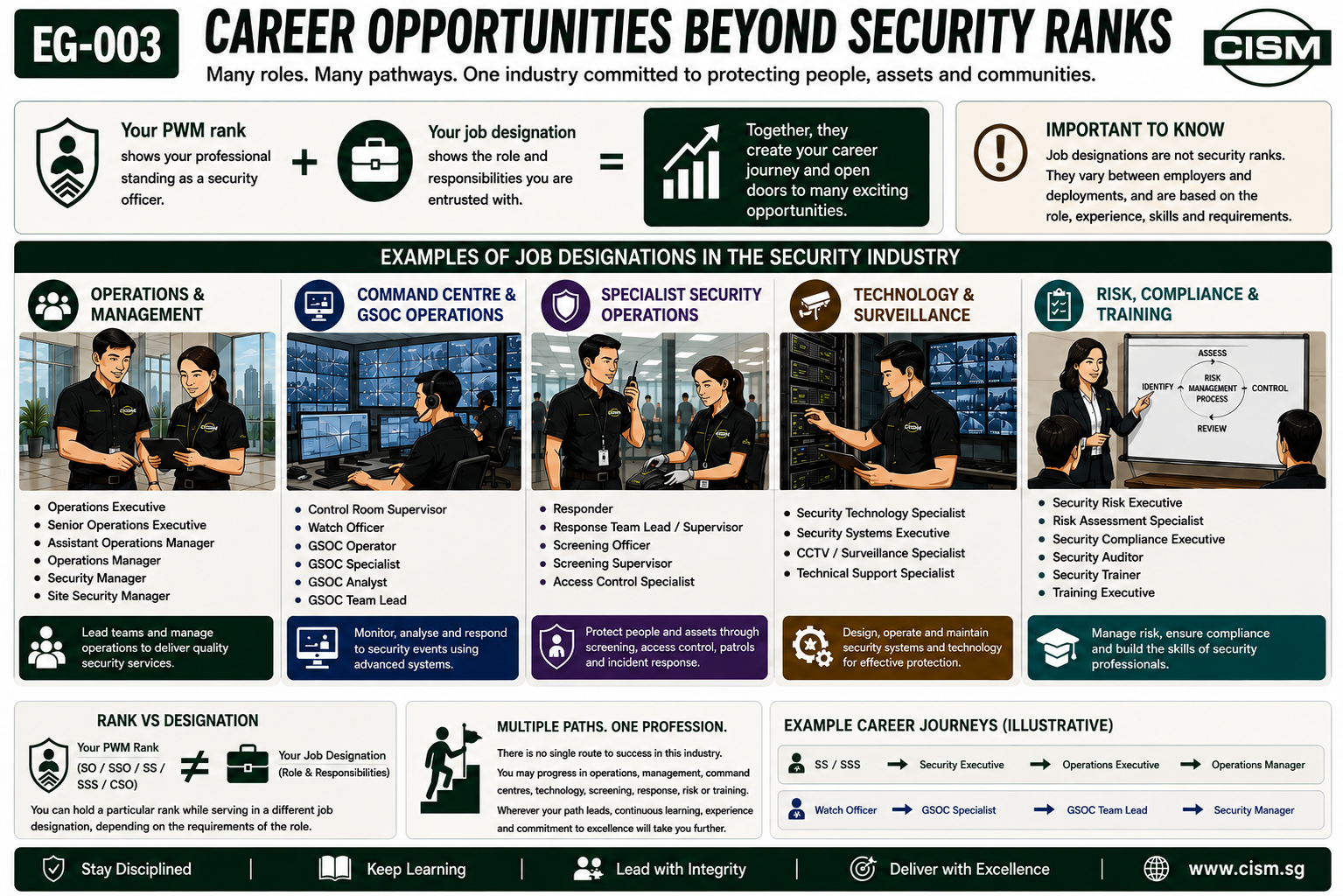
Career Opportunities Beyond Security Ranks
Security career development is not limited to moving vertically through SO, SSO, SS, SSS and CSO.
As officers build experience, technical knowledge, supervisory capability and operational understanding, they may also move into specialised or management appointments.
Operations Executive
Operations Manager
Security Manager / Site Security Manager
Watch Officer
GSOC Specialist
Control Room Supervisor
Responder
Screening Officer / Screening Supervisor
PWM rank and job designation are not always the same thing
Your security rank represents one aspect of your professional standing. Your actual appointment may reflect a specialised, operational, technical or management responsibility.
Wage Reference
Security PWM Wages: 2026–2028
For eligible full-time outsourced local security officers working 35 to 44 hours per week, the Security Progressive Wage Model requirements specify the following minimum monthly basic wages from 2026 to 2028:
These figures are the minimum monthly basic wage requirements under the Security PWM for full-time outsourced security officers working 35 to 44 hours per week. Actual remuneration may be higher depending on the employer, deployment, allowances and other employment terms.
Staying Licensed
Do You Need to Renew Your Security Officer Licence?
Yes.
A Security Officer licence is generally valid for five years. Before renewal, officers must complete the required Refresher Quiz and licence renewal process before submitting the renewal application.
Do not wait until your licence has expired before paying attention to renewal. Maintaining a valid licence is part of maintaining your ability to remain employed and deployed as a Security Officer.
Modern Security
Security Work Is Becoming More Technology-Enabled
Many modern security deployments now involve technology such as:
- CCTV and video surveillance.
- Electronic access control.
- Visitor-management systems.
- Alarm monitoring.
- Remote surveillance.
- Digital incident reporting.
- Security screening equipment.
Technology does not remove the need for capable Security Officers. It changes what capable officers need to be able to do.
Technology can provide information. The officer still needs to understand what that information means and what action should follow.
Candidate Checklist
Before Accepting a Security Job, Ask These Questions
- What type of site will I be deployed to?
- What are my actual duties?
- What is the shift pattern?
- What does the advertised salary consist of?
- Are there allowances or additional benefits?
- Is the site accessible by public transport?
- Will I receive site induction or OJT?
- Do I need additional certifications?
- Is the deployment permanent or relief-based?
- What happens if the client contract changes?
- Are there opportunities to progress to SSO or supervisory roles?
A professional employer should be able to explain the position clearly.
Officer vs Employer
Who Handles What?
For someone new to the industry, separating your responsibilities from your employer's responsibilities makes the onboarding process easier to understand.
You
- Apply for your Security Officer licence.
- Complete the required WSQ training.
- Obtain your Security Officer ID card.
- Provide accurate information during recruitment.
- Maintain your licence and training status.
- Learn and follow site procedures.
Your Employer
- Verify your licence and employment status.
- Submit the required employment notification to PRD.
- Submit cessation when employment ends.
- Arrange your deployment.
- Provide site instructions and onboarding.
- Conduct or arrange site induction / OJT.
The Journey in One View
Key Takeaways
Before Employment
Check Eligibility Apply for Licence Complete WSQ Training Obtain ID Card
Once You Are Hired
Employer Notification to PRD Site Induction / OJT Deployment
As You Gain Experience
SO → SSO → SS → SSS → CSO
Your starting point may be Security Officer.
It does not have to be your finishing point.
For people willing to learn, build experience and take on greater responsibility, security can develop into a longer-term career involving specialised operations, supervision, technology and leadership.